
What We Do With a Material Before We Know What It Wants to Become
Most materials arrive in the studio with no plan attached to them. That is deliberate.
This is perhaps the most counterintuitive thing about how the Reshaping Collection is made. There is no design brief, no mood board created in advance, no sketch that precedes the material. The material comes first — already present, already carrying its history — and the form follows from working with it, not from deciding what it should be before touching it.
This is slower than designing from a drawing. It produces objects that could not have been designed any other way.
What arrives and what it carries
The materials in the Reshaping Collection did not arrive as raw ingredients waiting to be transformed. They arrived as something already — pattern paper drafted and used and set aside, fabric lengths intended for garments that were never made, yarn and cord wound from a previous practice in fashion, metal rods bought for temporary storage in a Finnish home, beads and wire accumulated over years of making in a completely different discipline.
Each of these materials carries what it previously was. Not visibly, not in a way that announces itself in the finished object, but present nonetheless — in the way the material behaves under the hand, in the particular resistance it offers when pushed in a direction it does not naturally want to go, in what it is willing to do and what it refuses.
Working with materials that already have a history means never starting from nothing. It is always continuing a conversation that began somewhere else, in a different form, and arrived here looking for its conclusion.
What each material became
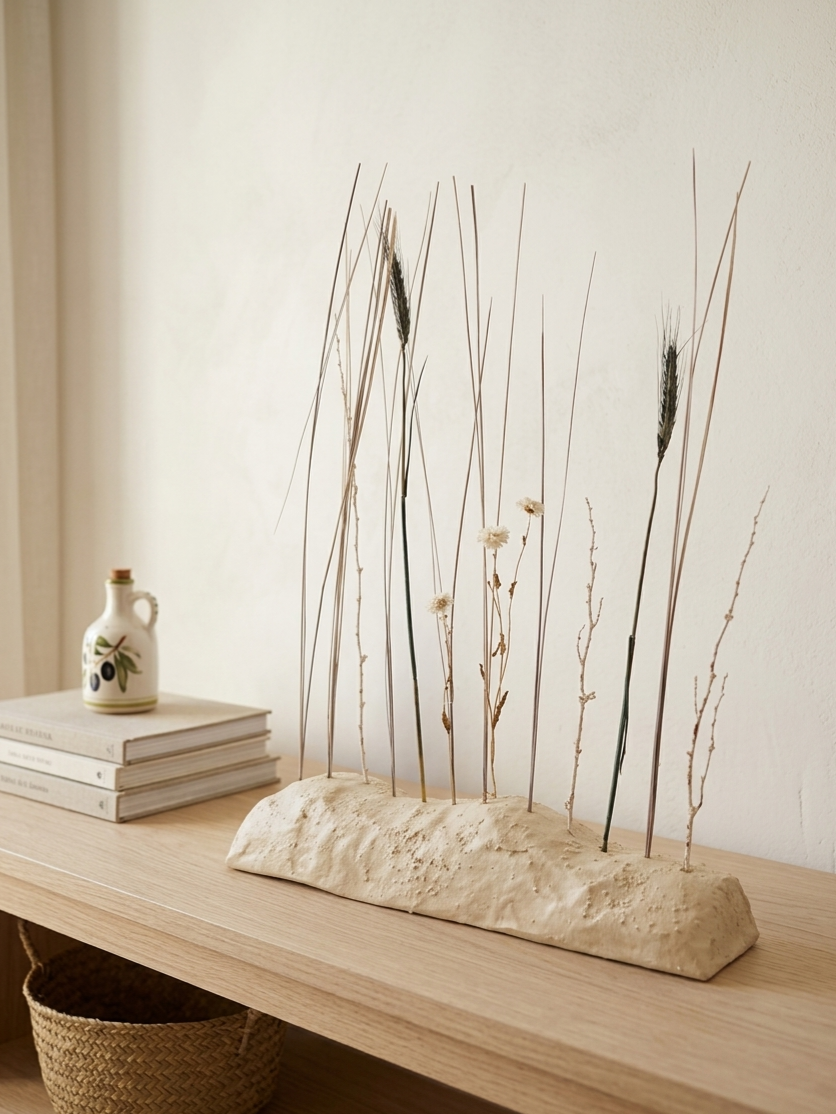
Paper was the first material to declare itself. Within the earliest experiments it was clear what layering could produce — how the binder behaved, how the mineral finish settled differently on raised areas than recessed ones, how the hand pressure during forming left marks that became features rather than flaws. Threshold, Soleil, Galets, Écorce, Penya, Alba, Jonc — all paper, all found through the same process of handling before deciding.
Yarn arrived from the same fashion practice that brought the paper. It sat in the studio for a period of handling and testing before the geometry of Trama emerged — six panels, hand-laid in tight parallel courses, an arc and a sun circle built from teal, navy, warm grey, and solar yellow. The yarn that had travelled across three countries found its final form as a single architectural composition for a wall. The weave was always in it. The studio just had to find the right geometry to release it.
Fabric asked yet more different questions again. Luna was the first and largest answer — draped, pushed into vertical channels, set in plaster, fixed permanently into a wall relief that reads as stone from across a room and reveals its textile origin only up close. But fabric did not stop there.
The same coastal stripe canvas that lined the interior of Safata — a flat rectangular tray with a blue PU leather exterior — had travelled from a fashion studio through a Nordic winter to a workroom overlooking the harbor at Palamós. Its final form is domestic and practical: a tray that carries the memory of the fabric without announcing it, the stripe visible only to whoever uses it daily. Embolcall took the same material logic further — waterproof fabric, gathered at the base into a sculptural foot, cut and sewn into planter covers that find their own form each time because no gathered base ever sits in exactly the same way twice. The door stops — pyramid, nautical anchor, striped canvas — are fabric over structure, weighted and finished, the kind of object that does a practical job while looking like it was made for something more considered than keeping a door open.
Fabric, across all of these pieces, behaves the same way — it follows its own fall, gathers where it wants to gather, resists where it wants to resist. The studio's job is to work with that resistance rather than against it, and to find the form that the fabric was already moving toward.
Cord asked different questions than yarn did, and gave different answers. It became Horitzó — a mixed media canvas where cord and other materials layer into a composition that is neither textile nor painting. It became the wrapping on the cardboard vases — jute and black cord giving a simple cylindrical form a surface that reads as coastal and handmade without announcing either quality too loudly. It became the coiling structure of the Ju Jus sculptural forms. It became the nautical motifs of the Marina coasters — anchor and boat, white cord on jute, blue leather trim. The same material, asked different questions by different forms, giving different answers each time.
Metal was the most unexpected conversation. The aluminum rods from Finland — bought for a temporary shelving system, carried to Palamós without a clear plan for what they would become there — eventually became Ona/Fissura and Espectre. Eighty-five centimeters wide, mounted on a wood panel with integrated LED lighting at the back, top and bottom. Dozens of rods in four finishes — teal, black, gold, silver — the complete Sinopia palette present in a single piece, arranged in a double wave that shifts between wall sculpture by day and light installation by night. One has already sold. The second sits in the studio with its LED backlight running. The rods that were storage infrastructure became the collection's most complex and resolved object.
The role of failure
Between a material arriving and a finished piece existing, there are always failed experiments. Forms that did not hold through drying. Surfaces that did not take the finish the way paper does. Proportions that seemed right in progress and wrong on completion.
These are not setbacks. They are information.
Every failed piece teaches something specific — about the material's limits, about what it can sustain and what collapses under its own weight, about the gap between what looked promising at one scale and what works at another. The Reshaping Collection is built on what the failures taught as much as what the successes produced.
The pieces that did not work are not in the collection. They are in the workshop — some kept as reference, some dismantled and returned to their material state. Still becoming, in a different sense than the finished pieces are finished.
The Sinopia Journal publishes weekly — design thinking, process, and the occasional strong opinion about how a room should feel.
What every finished piece was first
Every object currently in the Reshaping Collection was, at some point, an open question. Espectre was a bundle of aluminum rods with no wall to go on. Trama was cones of yarn with no geometry yet decided. The Marina coasters were a length of cord that had not yet found its nautical reference. Threshold was a pattern paper that had not yet decided to be an arch.
The making process is the process of allowing those questions to answer themselves — slowly, through handling and testing and occasionally failing, until the form arrives at something that feels inevitable. Not designed, exactly. Found.
The beads and wire are still in that earlier stage — accumulated over years, present in the studio, waiting for the right question. They will get there. Everything does, eventually, when you give it enough time, enough attention, and resist the temptation to tell it what it should be before it is ready to say.
The Reshaping Collection is made in Palamós — slowly, from materials that already existed, one form at a time.


Comments