
Jardí — A Garden That Never Needs Water
Every garden requires maintenance. This one requires none — and will look exactly the same in ten years as it does today.
This is not a selling point. It is a philosophical position. The Reshaping Collection is built on the idea that materials can be redirected into permanent form — that what was temporary can become fixed, that what was intended for one purpose can find a more enduring one. Jardí is the most literal expression of this idea in the entire collection. A garden made permanent. Flowers that do not die because they were never alive in the way flowers usually are.
The paradox is the point.
Where it began
The first Jardí was four flowers. Purple, pink, orange, yellow — the four colors that felt most instinctively right for a garden that was not trying to be realistic but was not trying to be abstract either. Something between the two: flowers that were clearly flowers, clearly handmade, and clearly not attempting to deceive anyone about what they were.
The base was paper — the same layered house pattern paper that the collection had already learned to work with, formed into a long rectangular block and finished in the same mineral white as the sculptural pieces. The flowers rose from it on wire stems, with painted paper grass blades alongside them. A garden in a box. A landscape compressed into a table-top object.
Jardí sold. And then something happened that the studio had not planned for.
The Sinopia Journal publishes weekly — design thinking, process, and the occasional strong opinion about how a room should feel.
The client who came back
The buyer of the first Jardí came back. Not for a second garden — she had bought a vase from the studio too, a wide terracotta form, and she wanted flowers for it. The same flowers she had bought in the original Jardí, but now as individual stems — eight of them, to arrange in her own vessel in her own way.
This is the kind of signal that changes the direction of a product line. The flowers had been designed as components of a larger composition — elements of a garden, inseparable from the base they grew from. The client showed the studio that they were not inseparable at all. They were stems. They could go anywhere.
Flors — the individual stem listing — exists because of that returning client. Eight stems she arranged in a vase she had already chosen. The garden moved off its base and became something else: a permanent botanical that could be commissioned in any palette, for any vessel, by anyone who wanted something on their table that would never wilt and never need replacing.
How the flowers are made
The process is faster than it looks and more precise than it sounds. Crinkled paper — the kind that already has texture and movement built into its surface before anything is done to it — is cut into petal forms, painted, each one slightly different from the ones either side of it. The petals are shaped by hand, given curve and dimension through pressure and manipulation, then assembled around a wire stem.
The painting is the part that makes each flower unique. The base paper is white, and the paint is applied in a way that leaves the white showing through — at the petal edges, in the lightest areas of each form, in the places where the crinkle of the paper catches the paint differently from the flat areas beside it. The result is a flower that has depth — not a flat coloured form but something with a light side and a shadow side, a centre that reads differently from the edge, a surface that rewards looking at closely.
Twelve stems in two hours. The speed is deceptive. The result looks like it took considerably longer, which is the correct outcome for any handmade object.
Jardí Fusta — when the garden found wood
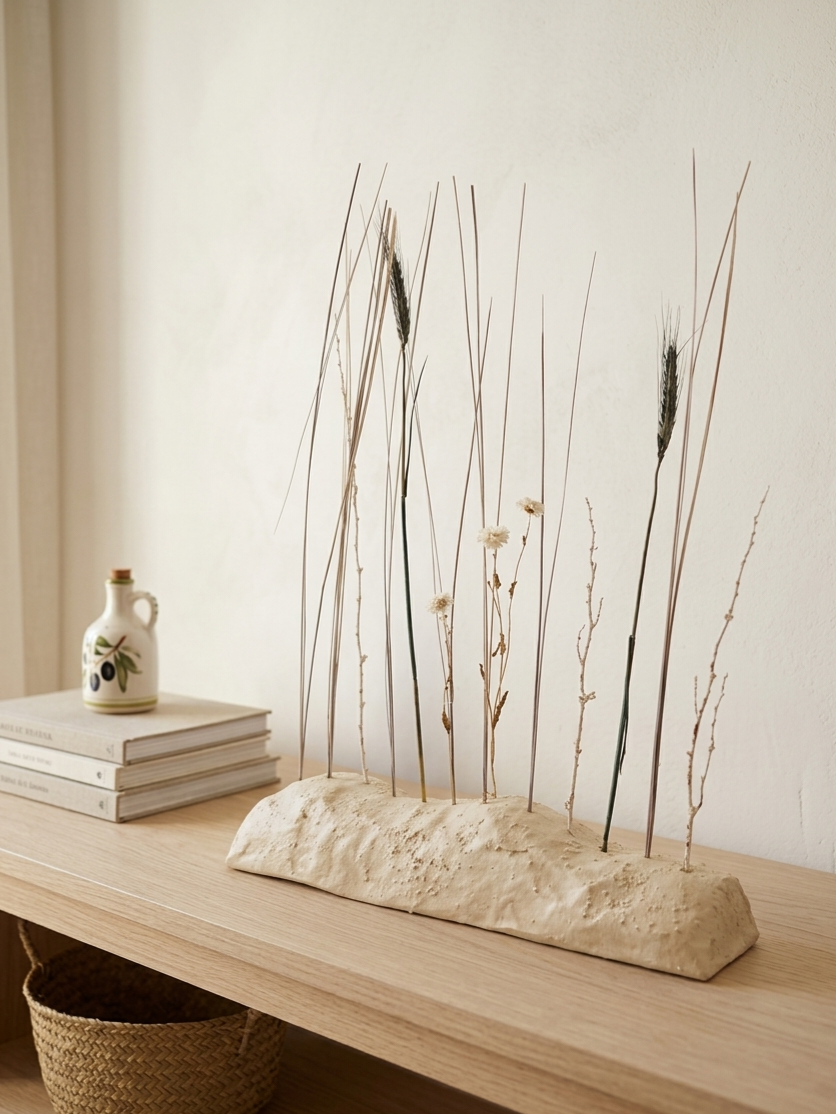
The second significant development in the Jardí family was the driftwood base. A found piece of wood — the kind that arrives on a Costa Brava beach after a storm, already shaped by water and time into something that no human hand could have produced deliberately — turned out to be a better base for a garden composition than the paper block had been.
Not better in every sense. The paper base has a unity with the paper flowers that the driftwood does not — the whole original Jardí is made from the same family of materials, which gives it a formal coherence that is its own quality. But the driftwood base introduced something the paper base could not provide: a found object, an object with its own history, an object that had already been shaped by the landscape before the flowers were added to it.
Jardí Fusta — fusta is Catalan for wood — became the mixed-material version of the garden. And with the driftwood base came the possibility of mixed flowers: paper, yes, but also yarn pompoms, fabric blooms, tissue paper forms, cord flowers. All on real dried branches planted into the wood. The palette expanded, the flower vocabulary grew, and the garden became the piece in the collection that contains the most materials simultaneously — a summation of everything the studio had learned to work with, arranged into a single composition.

The material vocabulary of a Jardí Fusta
Jardí Fusta is not a single material object. It is a composition — a decision about which materials to bring together and how to arrange them so that the differences between them create interest rather than confusion.
The paper flowers carry the original Jardí vocabulary: open, crinkled, painted at the edges, recognizably floral without being botanically precise. The yarn pompoms — made from the same chunky knitting yarn as Trama — are dense, tactile, spherical. They read as a different kind of flowering entirely: where the paper flowers are open and light-catching, the yarn pompoms are compact and light-absorbing. The contrast between them on the same type of branch is the visual engine of the composition.
The fabric flowers bring a third material language — softer than paper, less dense than yarn, with a surface that moves slightly when the air moves around it in a way that paper and yarn do not. Tissue paper adds the smallest and most delicate forms. Cord adds texture and density at a different scale from the pompoms.
Real dried branches carry all of this. Not wire stems, not artificial supports — actual branches gathered from the landscape around Palamós, already carrying their own structure and direction, already branching in ways that no studio decision could have designed. The flowers are attached to the branches at points where the branch's own logic suggests them. The composition is half designed and half found.
What the garden is becoming
Tronc-Disc arrived after Jardí Fusta — a driftwood trunk section with red paper disc flowers on bare silver wire stems, four flowers and four stems, minimal almost to severity. Where Jardí Fusta is abundant, Tronc-Disc is reduced. The same material origin — paper, wire, found wood — taken in a completely opposite compositional direction.
Branca is the branch without a base — a single dried branch with pompoms attached, designed to go into any vessel the buyer already owns. The garden form became portable. The flowers that began in a paper base, moved to driftwood, can now live in a terracotta wide vase or a ribbed ceramic or a dark earth vessel or anything else that can hold a branch upright.
Globus extended the yarn pompom vocabulary onto a single branch at a larger scale — the red pompoms that appear in the image taken in the apartment at El Mirador, the branch arranged in the large pale vessel with the sea visible through the window behind it. That image is the collection's most powerful photograph not because it was staged but because it was not — it is how the piece actually looks in the kind of home it was made for.

The garden that was always permanent
Cut flowers are the most perishable thing in any interior — bought for a specific occasion or a specific mood, beautiful for days, then gone. The pleasure they give is inseparable from their brevity. You appreciate them partly because you know they are leaving.
Jardí does not leave. It is there in October when the property is closed, in February when the Tramuntana is running, in April before the season begins. It does not require replacing, does not drop petals, does not need water or light or any of the maintenance that living flowers require. It just stays — the same colors, the same forms, the same composition — for as long as the studio that made it exists and the hands that made it are still making.
This is not a lesser version of a real garden. It is a different kind of permanence — the permanence of a made thing rather than a grown one. The Reshaping Collection is full of this logic: materials redirected into permanent form, things that were one thing becoming another thing that will last considerably longer. Jardí is simply the version of this logic that looks most like the world outside the window.
The garden was always there. This one just decided to stay.
Jardí Fusta, Branca, Tronc-Disc and individual Flors stems are available in the studio and online. Each composition is unique and unrepeatable.


Comments