
The First Thing We Change in Every Second Home

Updated: Jun 15
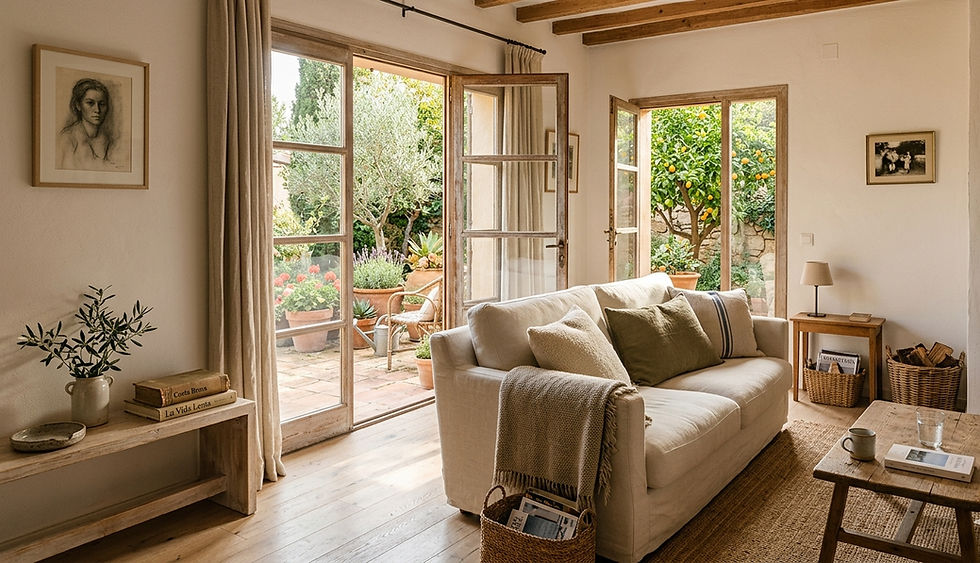
It is almost never the furniture. It is almost always the light.
This is the observation that surprises clients most consistently — the realization that the room they have been trying to fix with new sofas, new rugs, new paint colors, was never really a furniture problem or a color problem. It was a light problem. And once the light is resolved, everything else either works or becomes much easier to fix.
Light is the material that all other materials depend on. Color does not exist independently of the light falling on it. Texture is invisible without a directional source to reveal it. Scale is distorted by light that is too flat or too harsh. Every decision made in an interior — every carefully chosen fabric, every considered object, every paint color tested on a sample card — is contingent on the quality of the light in which it is seen.
In second homes, the light is almost always wrong. Not because the architecture is bad — often it is not — but because the lighting has never been properly considered as a system.

The three problems we find most often
After working across second home projects on the Costa Brava and beyond, the same light problems appear with enough regularity to have names.
The first thing that is wrong is temperature. Light has color — measured in Kelvins, running from warm amber at the low end to cool blue-white at the high end. Most second homes are lit with bulbs in the 4000–6000K range: bright, clean, practical, and completely wrong for a Mediterranean interior. Cool light flattens warm materials — it drains the life from terracotta, makes linen look grey, and turns the particular quality of Mediterranean afternoon into something that feels like a supermarket.
The fix costs almost nothing. Replacing cool white bulbs with warm white ones — 2700K is the right target — changes the atmosphere of a room more dramatically than any furniture purchase. It is the single highest-impact, lowest-cost intervention available in any interior. Do it first, before anything else.
The second problem is wrong position. The default lighting arrangement in most second homes is a ceiling fixture in the center of the room — a single source that illuminates the space evenly and, in doing so, creates no atmosphere whatsoever. Even light has no shadow. No shadow means no depth. No depth means a room that functions adequately and feels like nowhere in particular.
Light that creates atmosphere comes from the sides and from below — floor lamps, table lamps, wall-mounted sources at eye level or lower. These sources create pools of light rather than fields of it. The areas between pools become interesting. The objects within pools become three-dimensional in a way that overhead lighting never achieves.
The third problem is missing layers. Architectural lighting theory divides interior light into three categories: ambient, task, and accent. Ambient is the general illumination of the space. Task is focused light for specific activities — reading, cooking, working. Accent is directional light that highlights particular objects or surfaces.
Most second homes have ambient light only. Occasionally task lighting in a kitchen or next to a bed. Almost never accent lighting. The result is a room that is adequately lit but never truly alive—a space where the objects in it are seen but not revealed.
What a floor lamp actually does
The intervention we recommend most often, across more projects than any other single element, is a floor lamp.
Not because floor lamps are inherently special. Because they solve three problems simultaneously — they add a light source at the right height, they create a pool of warm light in an area that the ceiling fixture does not reach, and they introduce a vertical element that contributes to the composition of the room even when they are switched off.
A good floor lamp in the right position changes a room in the evening more than almost any other single purchase. It creates the difference between a room you turn the main light off in and a room where you turn the main light off and light the lamp instead — a transition that changes not just the brightness but the entire atmosphere of the space.
This is the kind of intervention the Quick Fix process identifies quickly. Not because it is complicated to spot, but because you need to see a room in its current evening light to understand what it lacks. Photographs taken in daylight do not reveal it. A visit at the right hour does.
The Sinopia Journal publishes weekly — design thinking, process, and the occasional strong opinion about how a room should feel.
When light cannot be fixed without structural work
Sometimes the problem is architectural rather than atmospheric — a room with no south-facing opening, windows placed too high to admit useful light, a floor plan that puts the living space in permanent shadow.
These situations require a different conversation. They are not Quick Fix territory — they are the beginning of an architectural project, a structural intervention that goes beyond bulb changes and lamp positions.
The honest answer in these cases is to say so clearly, early, and without softening it. A room with a fundamental light problem that cannot be resolved through atmospheric intervention needs an architect, not a stylist. Knowing the difference between the two situations is part of what the diagnostic process is for.
Most rooms, however, are not in this category. Most rooms have a light problem that is solvable — sometimes in an afternoon, sometimes over a weekend, sometimes with a single purchase and a change of bulb. The structural cases are rarer than clients fear.
The sequence
If you are looking at a second home that is not working and you do not know where to start, start here:
Replace every bulb in the property with a warm white 2700K equivalent. Add one floor lamp to the room that feels least resolved. Turn off the overhead lights in the evening and see what you have.
This takes an afternoon and costs less than most decorative objects. If the room still does not work after this, the problem is elsewhere and you know the light is not the issue. If the room transforms — which it usually does — you have your answer and your starting point.
Everything else follows from there.
A Quick Fix consultation begins with exactly this kind of diagnostic thinking — applied to your specific space, at the right time of day, by an architect who has seen this problem enough times to find it quickly.


Comments