
When a Quick Fix Becomes a Full Room

It started with one question about a sofa. It ended with a room that finally made sense.
This is not an unusual story. In fact it is the most common story we have — the client who arrives at a Quick Fix consultation with a specific, contained problem, and leaves having understood that the problem was never really about the sofa at all.
That is not a sales observation. It is an architectural one. Rooms do not malfunction in isolation. When something feels wrong — the proportions are off, the light does not behave, the space feels smaller or colder or more chaotic than it should — there is almost always a systemic reason. A single piece of furniture is rarely the cause. It is usually the symptom.
The consultation
A Quick Fix session is 45 minutes. It is not a design presentation, a mood board review, or a shopping appointment. It is a diagnosis — an architect's eye applied to a specific space with the specific question: what is actually happening here, and what would it take to change it?
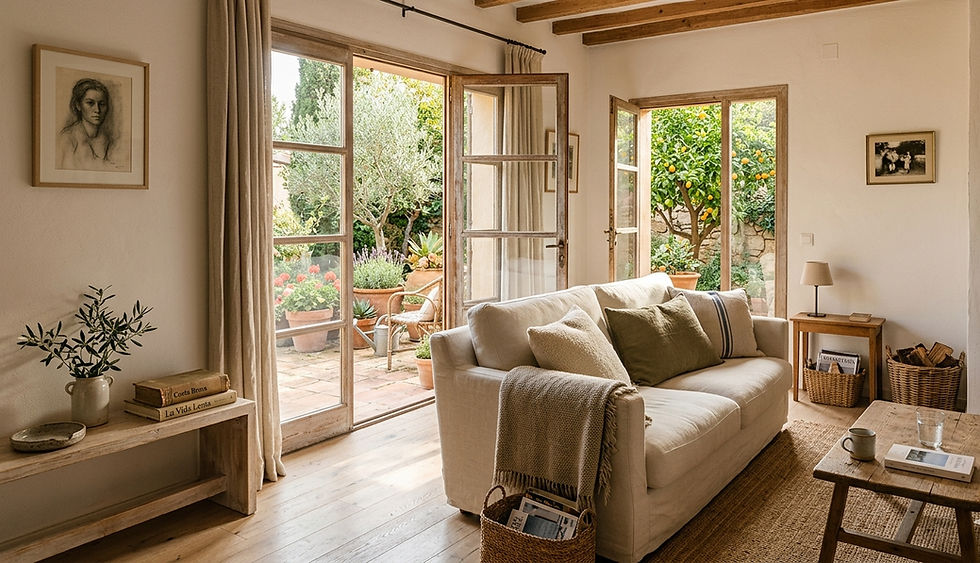
The client who came in about the sofa had a living room in a Costa Brava second home that she used every summer and rented for parts of the spring and autumn. The sofa was large — bought for a previous apartment in Amsterdam, shipped to Spain because it was good quality and felt wasteful to replace. It dominated the room in a way she had learned to work around rather than resolve.
The sofa was not the problem.
The problem was the room's relationship to the terrace — a set of glass doors that opened onto a south-facing outdoor space but were being treated as a wall rather than a threshold. The furniture arrangement closed the room off from its best asset. The sofa, large as it was, would have worked perfectly if the room had been arranged to move toward the light rather than away from it.
This is what 45 minutes with an architect can find. Not because the observation is complicated — it is actually very simple — but because it requires looking at the room as a system rather than as a collection of individual decisions.
The Studio Report
After the session, we produce a written Studio Report. Not a mood board. Not a shopping list. A document that articulates what we found, what we recommend, and — crucially — why.
The why is the part that matters most. Anyone can tell a client to move their sofa. The report explains the spatial logic behind the recommendation, so the client understands not just what to do but what they are trying to achieve. That understanding is what allows them to make good decisions independently — and what makes the next conversation, if there is one, immediately more productive.
For this particular client, the report covered three things: the furniture arrangement, the light management across different times of day, and the relationship between the interior palette and the exterior landscape visible through those glass doors. Three observations. Each one connected to the others. Each one actionable without requiring a full project.
She implemented two of the three recommendations herself within a week. The third — the palette — she came back about a month later to discuss further.
The Sinopia Journal publishes weekly — design thinking, process, and the occasional strong opinion about how a room should feel. → Subscribe on Substack
When the scope expands
The conversation that turns a Quick Fix into a full room project is never a sales conversation. It happens because the client, having seen what one hour of architectural thinking produced, wants to know what a deeper engagement would look like.
In this case the question was simple: if you can see all of that in 45 minutes, what would you do with the whole room if we started properly?
That question is the beginning of a full interior design project. Not because we pushed toward it — we did not — but because the diagnostic process had shown the client something she had not been able to see before. The room had more potential than she had given it credit for. And she wanted to realize it.
The full single-room project that followed took the living space from a functional but unsatisfying space into something that worked with the building, the light, and the landscape rather than against them. The sofa stayed. Repositioned, with the room arranged around the terrace rather than away from it, it was exactly the right piece all along.
What this means for your space
The entry point is always the right place to start. Not because a Quick Fix will necessarily become something larger — sometimes 45 minutes is genuinely all a space needs — but because it gives you real information about what you are working with before you commit to anything.
The most expensive interior design mistakes are not the wrong sofa or the wrong color. They are the structural decisions made without understanding the space first — the kitchen extension that closes off the garden view, the open plan conversion that destroys the acoustic quality of a home, the renovation that adds square meters but loses the character that made the property worth buying in the first place.
A Quick Fix consultation costs €95. A structural mistake costs considerably more, in every sense.
Start with the diagnosis. The rest follows from there.
The Quick Fix consultation is available online and in-person at the studio in Palamós. The Studio Report is included.


Comments